Re:Act! - Evoking Change
To “react” means to change or move in a specific way based on the direct influence of a particular stimulus.
Kategori:
Event
Forfatter:
Josina & Audun
Dato:
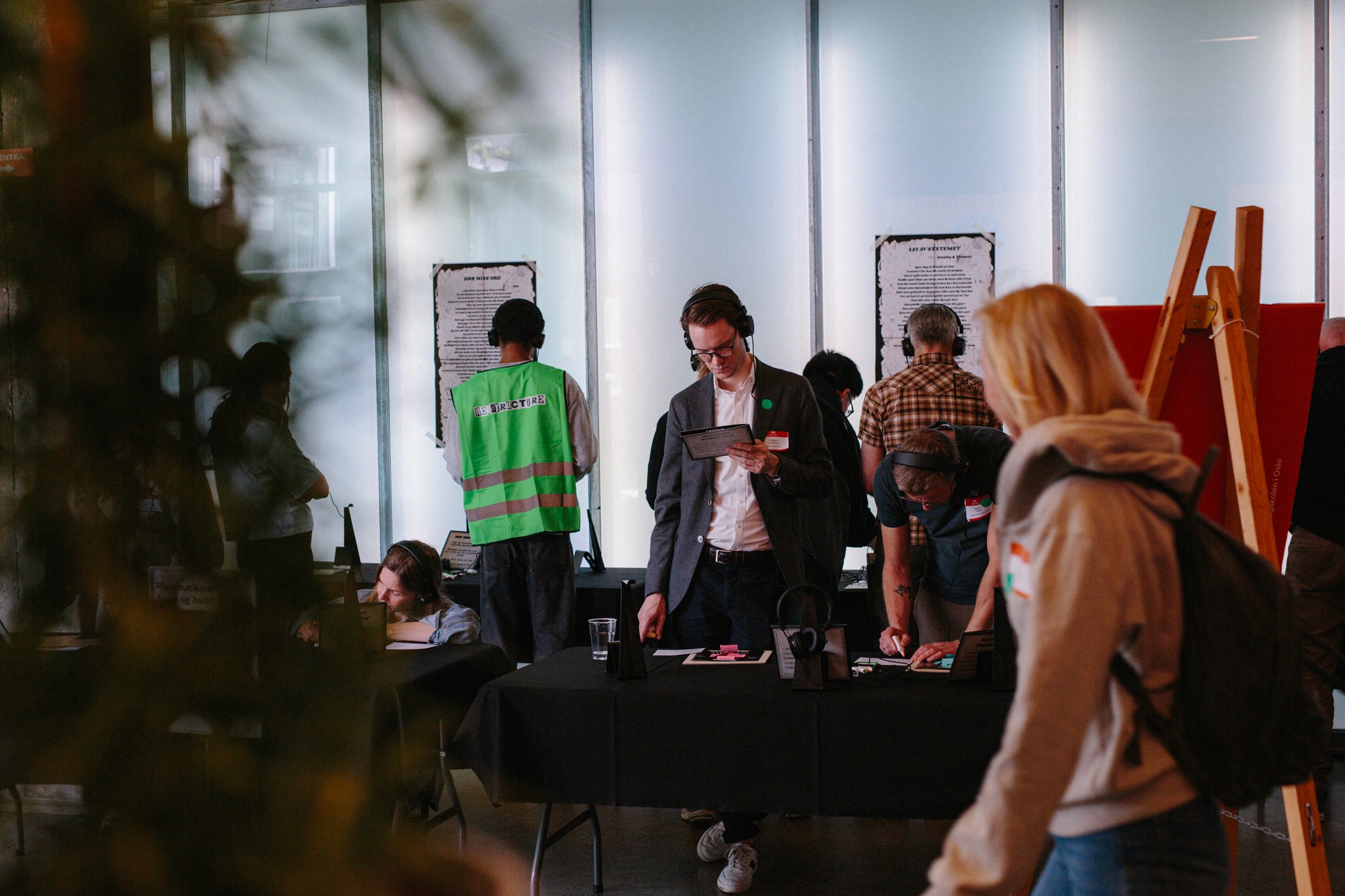

On May 27th, 2026, we opened our traveling exhibition Re:Act! at AHO in Oslo and have since staged it in Trondheim and Asker with youth, politicians, and service providers there. After summer, we head to Bærum before the exhibition opens on October 22nd at Henie Onstad for public viewing. The exhibition was created by more than 50 youth from Bærum, Asker, and Trondheim and includes 8 installations intended to provoke discussions on how structures in municipal services, like school, child welfare, and healthcare, can contribute to excluding some youth. Through diverse media, these installations create a call for action from youth to those working in and influencing municipal services. To give you a sense of the exhibition, one installation allows participants to peer into black boxes that reveal miniature models of everyday life situations experienced by trans and gender nonconforming youth. Another installation shows a documentary depicting how young people who have been involved in the criminal justice system are trapped by the labels placed on them and the surveillance enacted by teachers and police. Yet another invites participants to listen to five hip hop songs in a record store and unpack the lyrics.

There are collages of what it is like to be outside of school for years and how services treat you and expect you to know what is wrong. In another installation, participants in the exhibition can sit down at the desks of students in a special education classroom and get a window into their world. Participants can also see the everyday objects that are just out of reach for young people seeking asylum without their parents in Norway. One more installation invites people to play a game about the pointlessness of school. In a final installation, participants can put on a headset, listen to a podcast of youth’s experiences of racism, criminalization, and institutionalization, and record their own reaction episode. As we travel with these installations, we have witnessed tears stream down people’s cheeks listening to these hip hop songs or heard about how one municipal staff person working in human resources was moved to make the protocol for hiring youth in the local municipality easier. There have indeed been reactions. We can see that there is something happening in parallel, or rather within, the process of informing the system about the experiences of young people. It’s not just about informing but also evoking. Sure, it is about the content of what youth are sharing, but it’s also how they are doing it and what happens when it is taken in by other people. Truthfully, this exhibition has been quite chaotic, with lots of moving pieces – more than can be controlled. And experiencing the exhibition can be a bit chaotic too, bringing forward many inputs from youth with different backgrounds and experiences. But that is part of the point, not to flatten the experience of youth exclusion into one thing. This also means that people participating in the exhibition will likely have very different experiences and take away different things. Having youth express themselves and share their knowledge has been critical, but so is its digestion by those in the system. Part of our goal with this work has been to help politicians, service providers, leaders, and civil servants coming to the exhibition to yield and allow themselves to be affected. Not simply to validate what they already know, but to let themselves be surprised by what they experience and let it move them to action. We have heard bits and pieces about minor and major actions that participating in the exhibition has catalyzed, including a teacher describing how she is now working differently, letting learning be led by students’ interests, or one of the hip hop songs being played in a Bærum city council meeting. And we have some big plans around next steps for experimenting with changing the structures in municipal services that have been revealed through these installations. We don’t know exactly the reaction that this exhibition has brought up for all participants, what associations they have made, or how it has moved them. But when interacting with the close to 300 people that have been through the exhibition so far, we can feel a buzz, a groundswell, a growing collection of connected folks in the system shifting their posture. Note: to check out the digital materials from the installations, visit our Re:Structure Notion site, which is linked at the top of the “Work In Progress” section of our webpage.








Finansiert av: