Taking a Systemic Approach to Prevention
During the Winter of 2026, thirty third-year design students from The Oslo School of Architecture and Design (AHO) participated as co-researchers in the Re:Structure research project as part of their Introduction to Systems Oriented Design course.
Kategori:
Activities
Forfatter:
Jonathan
Sted:
AHO
Dato:
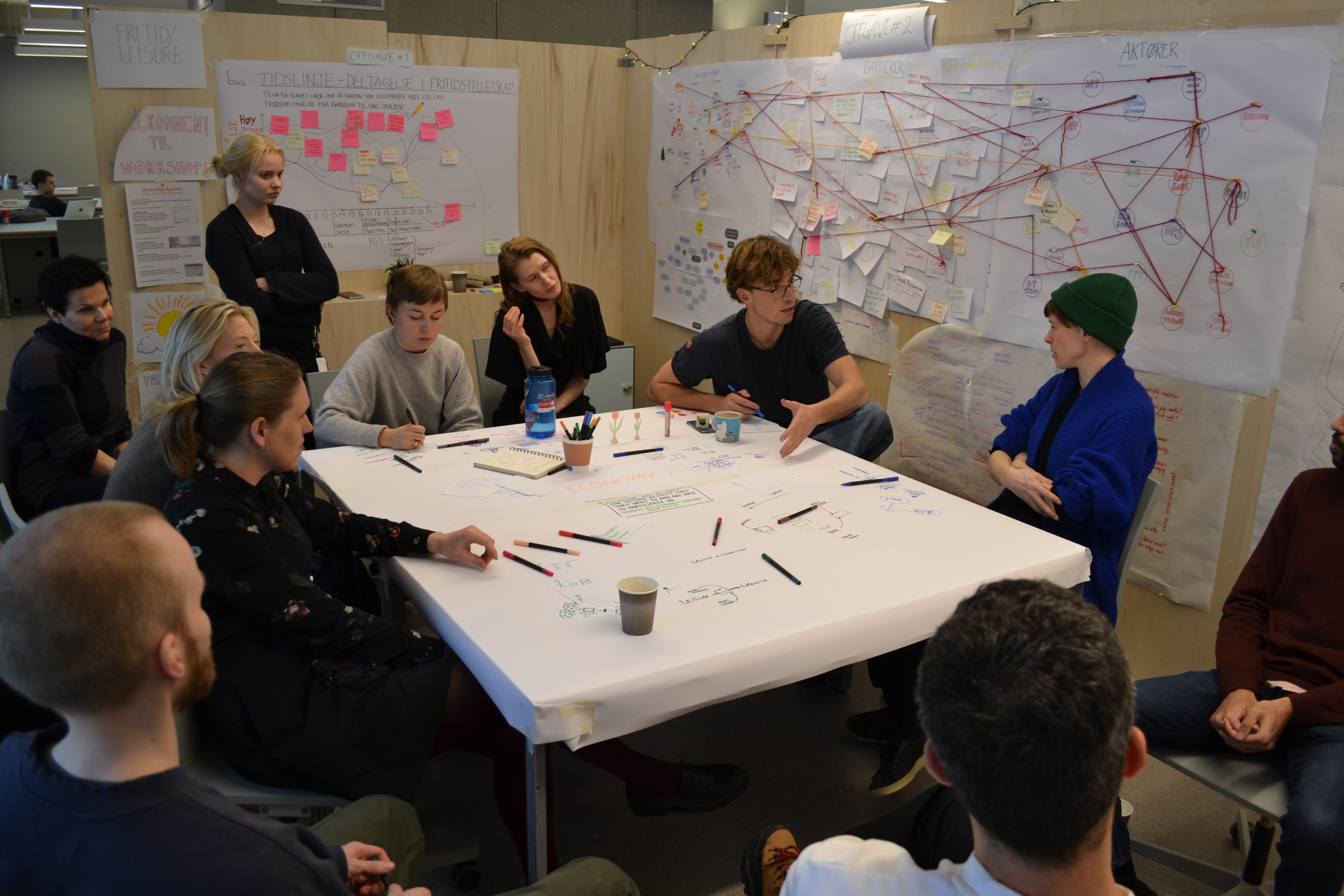
Systems Oriented Design is a collaborative design methodology and praxeology, developed at AHO, geared to address complex challenges and propose innovative interventions to resolve them. During the course, student teams were invited to explore the tensions between belonging and otherness, as well as inclusion and exclusion for today’s youth in Norway, across six everyday areas: 1. Family 2. Friends 3. Work 4. Health 5. Education 6. Leisure interests The primary goal of this initiative was to identify systemic leverage points that could help prevent youth from facing exclusion. Below are some key takeaways from the students’ work and the discussions their work provoked: - The extent to which the interventions to prevent youth marginalization should be institutionalized opened-up lingering questions. It is difficult to determine which aspects of prevention should be formalized and/or standardized, as universalist ideals might undermine distinct identities or expressions. For example, a tension emerged between the roles and cultures of diverse families vs. the role of the state. - The underlying assumptions and metaphors we have about our relations shape our society. Utilizing metaphors such as “monoculture”, where sameness is an ideal, and “polyculture”, referring to ideals of diversities strengthening each other were experienced as effective in reflecting on our social fabric and helping to catalyse necessary shifts in mindsets. - It is essential to intervene at multiple levels and points within the system to support the desired changes toward prevention. Sometimes marginalization stems from an accumulation of small slippages rather than one significant systemic failure, making it hard to identify when and where intervention is needed. - There is power in renewing our language and evolving our perception of categories when thinking about marginalization. For example, how we relate to diagnosis or the divisions we make between students in the educational system can have a significant impact on one’s sense of belonging. - Developing and implementing an adaptive learning system on youth marginalization that spans across time and space is needed. This could involve, for example, connecting insights from what happens in high school to interventions in early school grades through regular feedback loops. - There is a tension between existing metrics (such as PISA tests and NEET statistics) and the broader goals of education, well-being and belonging that current measurement systems fail to capture. More work is needed around how we can evolve our evaluation structures to better align with preventative aspirations. In the first three weeks of the course, students collected, mapped, and analysed extensive information from various sources regarding each of their themes. In the latter four weeks, the student teams were focused on framing leverage points, developing desired future scenarios, and compiling portfolios of proposed interventions aimed at helping youth become more resilient and preventing marginalization. The process included three half-day co-design and feedback sessions with a diverse team of “context navigators” from the Re:Structure project and beyond. At one point during the course, the Norwegian national task force for the inclusion of children and youth (“Ingen barn og unge utanfor!”) visited the class, engaging in meaningful dialogues with the student teams. The course was concluded with a full-day session where navigators and invited guests reviewed and provided feedback on the students' final work.
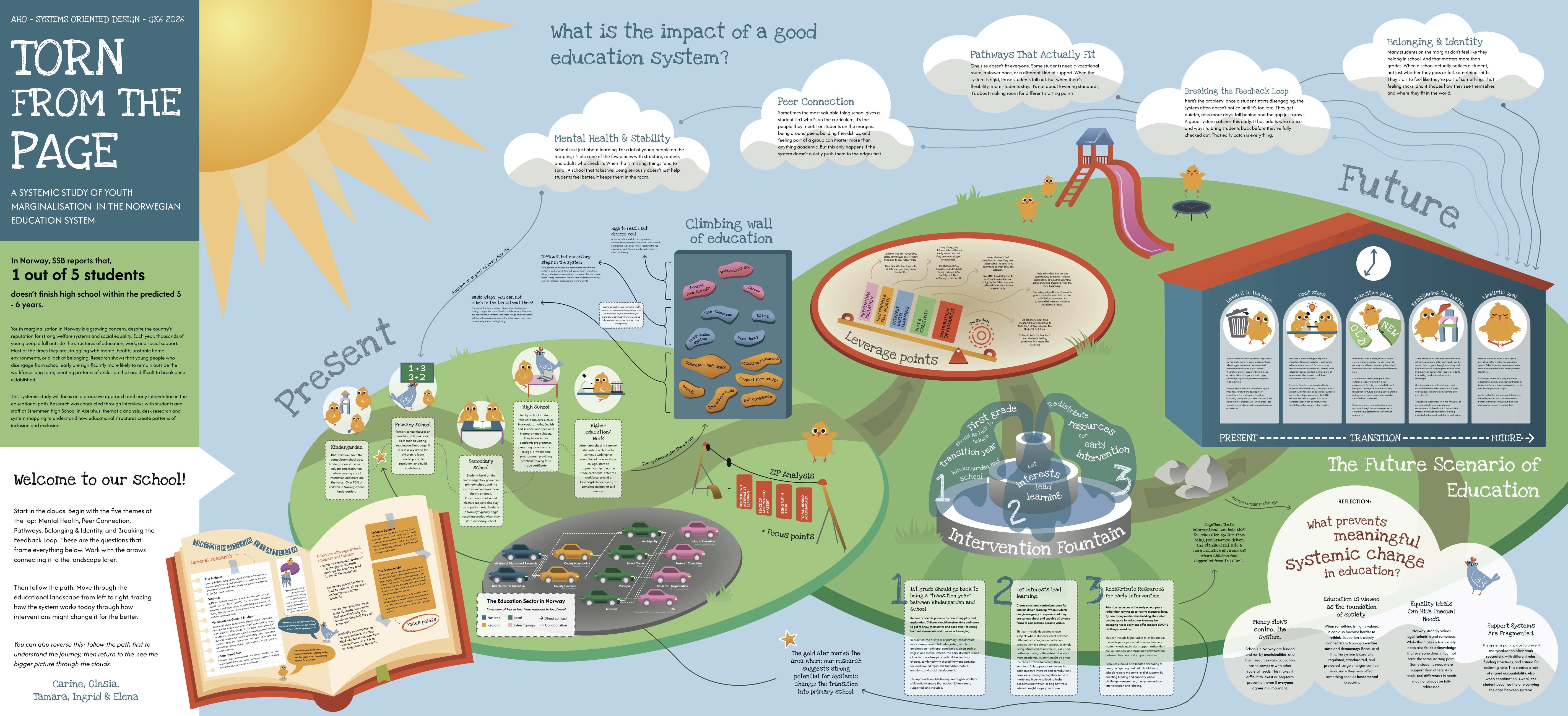
Above: Example of a Communication Gigamap delivered by the “Education” student team - Elena Borup, Ingrid Gryteselv, Tamara Harbakk Stene, Olesia Talmaza and Carine Wille-Johansen. The main research contribution made by the student teams were six large, plotted Communication Gigamaps: accessible visual representations of the complexities involved, the desired future scenarios, the identified leverage points for each thematic area, and examples of interventions within each context. Above is an example of one of the Gigamaps that were presented at the end of the course. Additionally, the student teams were challenged to develop and present dialogic boundary objects (physical design materials) that could inspire dialogue and build bridges between different stakeholders in the Re:Structure project and beyond. Below is an example of a boundary object that illustrates the many pitfalls that a young person may experience in falling out of the current healthcare system in Norway. A collection of all student team deliveries can be accessed here on the Re:Structure Notion site: https://restructure.notion.site/A-Systemic-Exploration-of-Preventing-Outsiderness-328b0d8f362980b6bc4bd41d945cb547. Grap a cup of tea or coffee—they are definitely worth taking some time to meander through. Below: Example of a boundary object delivered by the “Healthcare” student team – Lian Maij Biglari, Hedda Mcclean, Frøydis Line Furland, Kristian Øyan and Heidi Holter-Hovind.










Finansiert av: