Re:Act! - Evoking Change
To “react” means to change or move in a specific way based on the direct influence of a particular stimulus.
Category:
Event
Author:
Josina & Audun
Date:
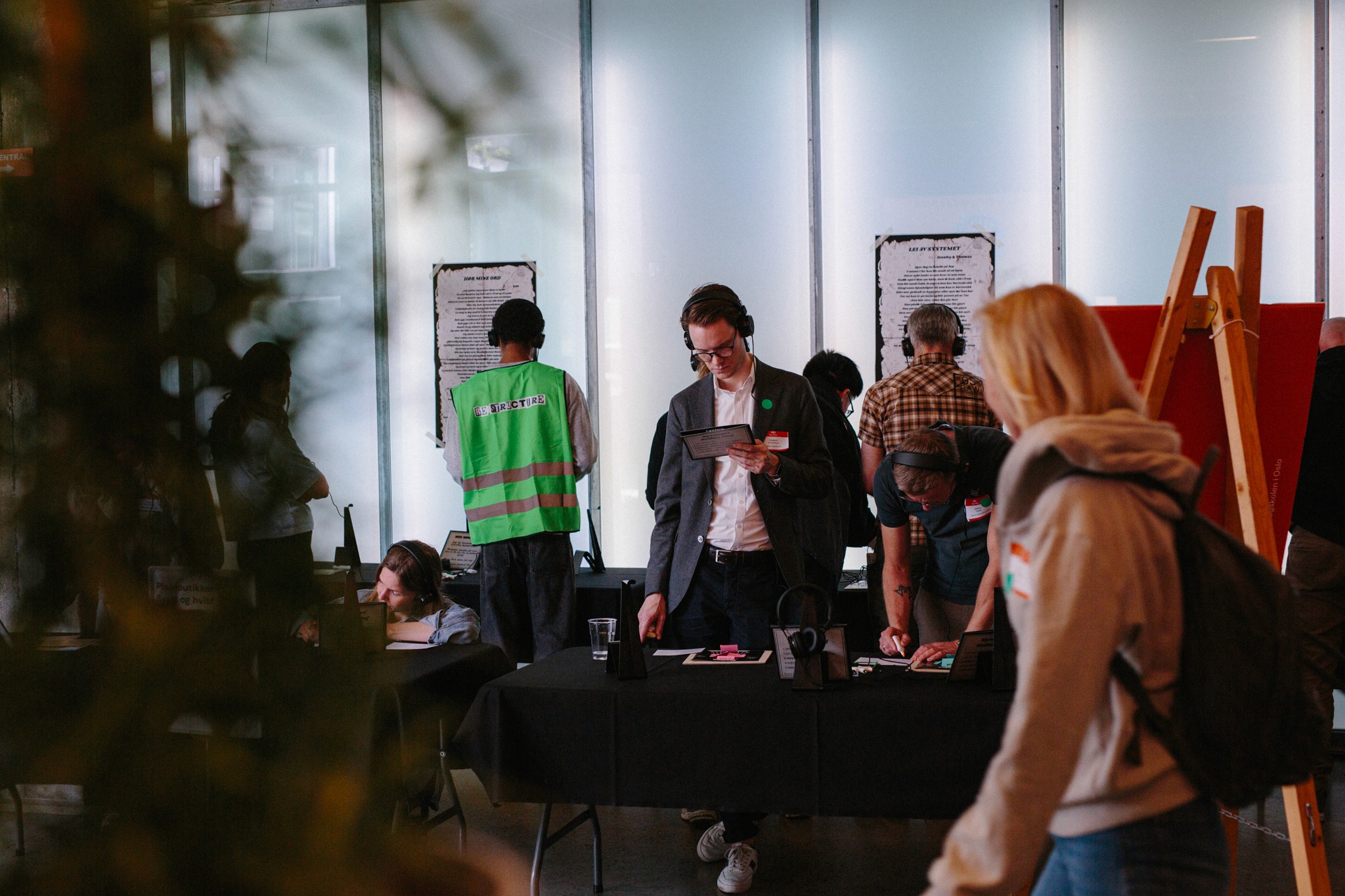

On May 27th, 2026, we opened our traveling exhibition Re:Act! at AHO in Oslo and have since staged it in Trondheim and Asker with youth, politicians, and service providers there. After summer, we head to Bærum before the exhibition opens on October 22nd at Henie Onstad for public viewing. The exhibition was created by more than 50 youth from Bærum, Asker, and Trondheim and includes 8 installations intended to provoke discussions on how structures in municipal services, like school, child welfare, and healthcare, can contribute to excluding some youth. Through diverse media, these installations create a call for action from youth to those working in and influencing municipal services. To give you a sense of the exhibition, one installation allows participants to peer into black boxes that reveal miniature models of everyday life situations experienced by trans and gender nonconforming youth. Another installation shows a documentary depicting how young people who have been involved in the criminal justice system are trapped by the labels placed on them and the surveillance enacted by teachers and police. Yet another invites participants to listen to five hip hop songs in a record store and unpack the lyrics.

Many of the young people who have worked with Re:Structure say that outsiderness doesn’t feel like a particularly relevant term to them. This echoes findings from Perspektivmelding Ung, in which none of the more than 1,600 young people surveyed described themselves as experiencing “outsiderness”.
Yet outsiderness has become an increasingly important policy category. Substantial resources are devoted to understanding, preventing and reducing it.
Last year also saw the launch of one of Norway’s first national missions. Called No child or young person left outside!. The mission aims to mobilize a broad range of actors to significantly reduce outsiderness among children and young people by 2035.
Like Re:Structure, the mission is concerned with systemic change. Still, I wonder whether the way the problem itself is framed pulls us in a different direction. The problem is that too many children and young people are on the outside, and the solution is to get better at preventing and reducing that outsiderness.
Even though the ambition is to change systems, the stated goal is for fewer young people to be on the outside. I think this way of talking about the problem makes it easier to focus on young people, but harder to see what pushes them out.
To change systems, I think we need to start talk more about exclusion. While outsiderness describes where people are, exclusion draws attention to what puts them there.
Focusing on the mechanisms that push people out opens up questions such as: Which norms and expectations make it difficult for young people to participate? What roles and communities do we offer them? And how do we need to change services so that financial circumstances or cultural background don’t stand in the way of everyone contributing?
Re:Structure, like the national mission, aims to bring about systemic change. We should therefore use language that makes the system itself a more explicit part of both the problem and the solution.
If the problem is that many young people experience outsiderness, it’s natural to want to prevent them from ending up there. If the problem is exclusion, we also have to ask what we need to stop and what we need to change. There is a difference between preventing outsiderness and stopping exclusion. Perhaps we could also turn our attention to creating inclusion.
So I’m going to start talking more about exclusion. Not because the word itself solves anything. But because it helps me focus on what we actually need to change.











FUNDED BY: