Taking a Systemic Approach to Prevention
During the Winter of 2026, thirty third-year design students from The Oslo School of Architecture and Design (AHO) participated as co-researchers in the Re:Structure research project as part of their Introduction to Systems Oriented Design course.
Category:
Activities
Author:
Jonathan
Location:
AHO
Date:
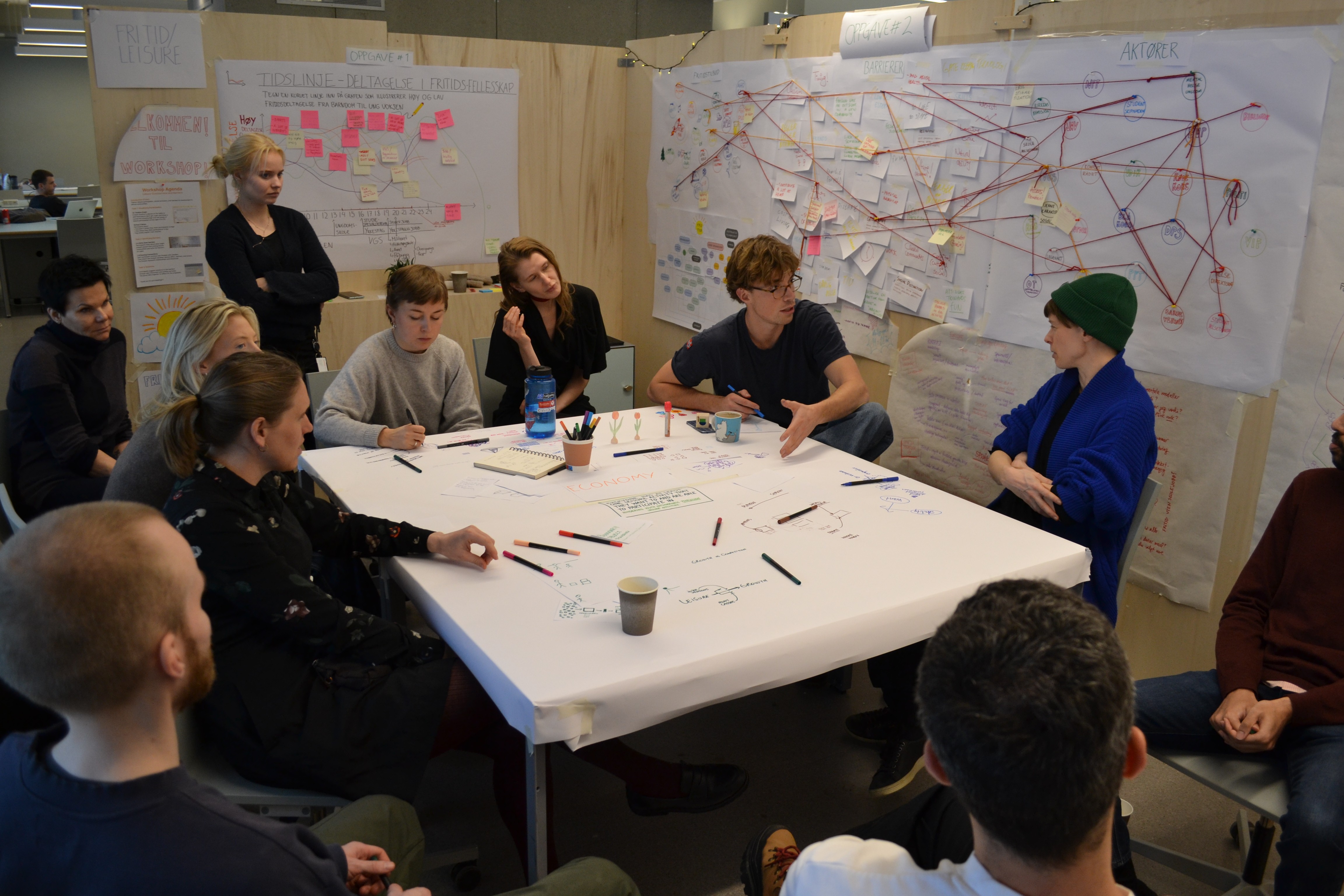
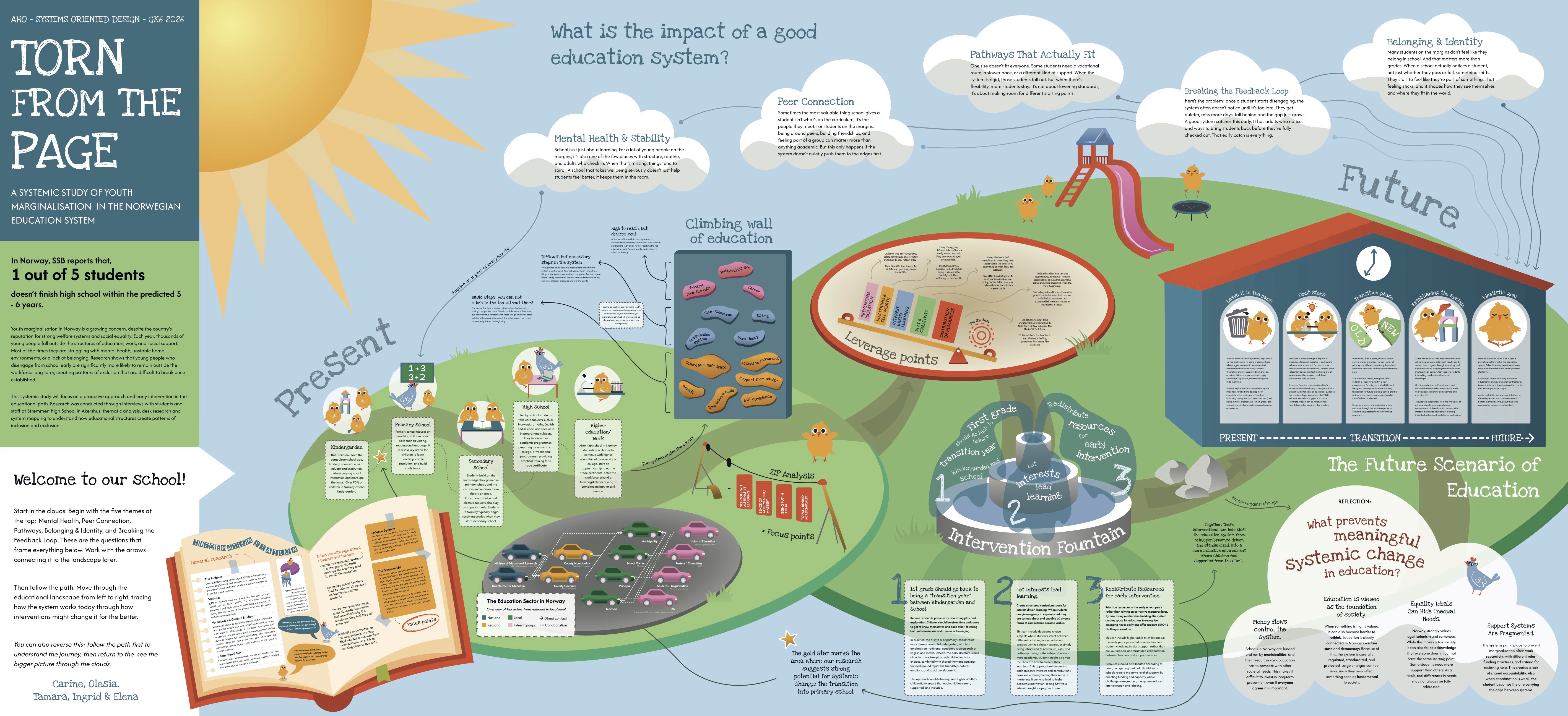
Systems Oriented Design is a collaborative design methodology and praxeology, developed at AHO, geared to address complex challenges and propose innovative interventions to resolve them. During the course, student teams were invited to explore the tensions between belonging and otherness, as well as inclusion and exclusion for today’s youth in Norway, across six everyday areas: 1. Family 2. Friends 3. Work 4. Health 5. Education 6. Leisure interests The primary goal of this initiative was to identify systemic leverage points that could help prevent youth from facing exclusion. Below are some key takeaways from the students’ work and the discussions their work provoked: - The extent to which the interventions to prevent youth marginalization should be institutionalized opened-up lingering questions. It is difficult to determine which aspects of prevention should be formalized and/or standardized, as universalist ideals might undermine distinct identities or expressions. For example, a tension emerged between the roles and cultures of diverse families vs. the role of the state. - The underlying assumptions and metaphors we have about our relations shape our society. Utilizing metaphors such as “monoculture”, where sameness is an ideal, and “polyculture”, referring to ideals of diversities strengthening each other were experienced as effective in reflecting on our social fabric and helping to catalyse necessary shifts in mindsets. - It is essential to intervene at multiple levels and points within the system to support the desired changes toward prevention. Sometimes marginalization stems from an accumulation of small slippages rather than one significant systemic failure, making it hard to identify when and where intervention is needed. - There is power in renewing our language and evolving our perception of categories when thinking about marginalization. For example, how we relate to diagnosis or the divisions we make between students in the educational system can have a significant impact on one’s sense of belonging. - Developing and implementing an adaptive learning system on youth marginalization that spans across time and space is needed. This could involve, for example, connecting insights from what happens in high school to interventions in early school grades through regular feedback loops. - There is a tension between existing metrics (such as PISA tests and NEET statistics) and the broader goals of education, well-being and belonging that current measurement systems fail to capture. More work is needed around how we can evolve our evaluation structures to better align with preventative aspirations. In the first three weeks of the course, students collected, mapped, and analysed extensive information from various sources regarding each of their themes. In the latter four weeks, the student teams were focused on framing leverage points, developing desired future scenarios, and compiling portfolios of proposed interventions aimed at helping youth become more resilient and preventing marginalization. The process included three half-day co-design and feedback sessions with a diverse team of “context navigators” from the Re:Structure project and beyond. At one point during the course, the Norwegian national task force for the inclusion of children and youth (“Ingen barn og unge utanfor!”) visited the class, engaging in meaningful dialogues with the student teams. The course was concluded with a full-day session where navigators and invited guests reviewed and provided feedback on the students' final work.
Many of the young people who have worked with Re:Structure say that outsiderness doesn’t feel like a particularly relevant term to them. This echoes findings from Perspektivmelding Ung, in which none of the more than 1,600 young people surveyed described themselves as experiencing “outsiderness”.
Yet outsiderness has become an increasingly important policy category. Substantial resources are devoted to understanding, preventing and reducing it.
Last year also saw the launch of one of Norway’s first national missions. Called No child or young person left outside!. The mission aims to mobilize a broad range of actors to significantly reduce outsiderness among children and young people by 2035.
Like Re:Structure, the mission is concerned with systemic change. Still, I wonder whether the way the problem itself is framed pulls us in a different direction. The problem is that too many children and young people are on the outside, and the solution is to get better at preventing and reducing that outsiderness.
Even though the ambition is to change systems, the stated goal is for fewer young people to be on the outside. I think this way of talking about the problem makes it easier to focus on young people, but harder to see what pushes them out.
To change systems, I think we need to start talk more about exclusion. While outsiderness describes where people are, exclusion draws attention to what puts them there.
Focusing on the mechanisms that push people out opens up questions such as: Which norms and expectations make it difficult for young people to participate? What roles and communities do we offer them? And how do we need to change services so that financial circumstances or cultural background don’t stand in the way of everyone contributing?
Re:Structure, like the national mission, aims to bring about systemic change. We should therefore use language that makes the system itself a more explicit part of both the problem and the solution.
If the problem is that many young people experience outsiderness, it’s natural to want to prevent them from ending up there. If the problem is exclusion, we also have to ask what we need to stop and what we need to change. There is a difference between preventing outsiderness and stopping exclusion. Perhaps we could also turn our attention to creating inclusion.
So I’m going to start talking more about exclusion. Not because the word itself solves anything. But because it helps me focus on what we actually need to change.











FUNDED BY:
